| |
| Mr Aron Long,an excellent
local English Guide in Shanghai!1.Shanghai city tour (Sightseeing,Shopping,Leisure,Golfing,Working,Nightlife)2.Business
tour/interpretation (International Exhibition,Conference)3.Family
tour 4.Outdoor camping near Shanghai5.water-town guiding in Shanghai6.Airport
pick-up service (Shanghai Pudong /Hongqiao Airport)7.Vehicle rental(Car,Van,Mini-bus)8.Flight&
Hotel booking 9.Accompanying service around China.Shanghai Map, Weather,Shanghai
Local Time,Currency & Exchange,Chinese Food & Snack,Shanghai Local
Phone Calls,Visa & Customs,Useful Chinese ABC,Useful Conversions,Consulates
in Shanghai,Int'l Hospitals in Shanghai,Int'l Kindergartens & Schools,Chinese
Traditional Festivals,Chinese Traditional Music |
|
|
|
|
|
ARON'S SERVICE LIST
|
|
|
|
|
|
|
|
|
|
|
|
|
|
|
|
|
|
|
|
ARON'S USEFUL RESOURCES
|
|
|
|
|
|
|
|
|
|
|
|
|
|
|
|
|
|
|
|
|
|
|
|
|
|
|
|
|
|
|
|
|
|
|
|
|
|
|
|
Book Aron by phone:
0086-13564008294
|
|
|
 |
| |
|
|
|
Location: Puxi <check
map>
Type: outdoor, by walk, river
side
Opening time: 24 hours
Length of visit: half an hour
Aron's tip:
 Here you can find a line of western
buildings left by Chinese Opium War.
Here you can find a line of western
buildings left by Chinese Opium War.
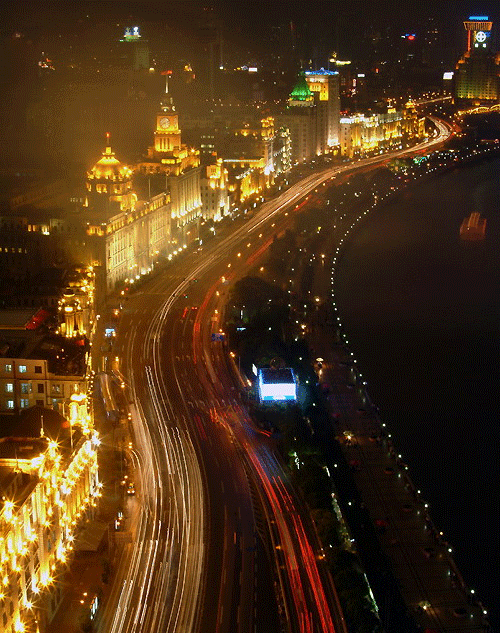
Night view of the Bund would be very
different from what it is in daytime.
It would make you feel the most colorful
Shanghai. |
|
|
|
The symbol of old and new Shanghai, the Bund
(officially known as Zhongshan Lu) is Shanghai's
most famous landmark. The name "Bund"
is from an Anglo Indian term meaning the muddy
embankment on the waterfront, and it is the
Huangpu River which helps create the uniquely
colonial feel here and provides a feeling
of space and openness which is lacking elsewhere
in the city. Four kilometers long, the Bund
has long been one of the most important areas
in Shanghai. In the 1930s, the row of buildings
was host to the city's financial and commercial
centers and the world's greatest banks and
trading empires established a base here.
At the North end of the Bund and just over
Waibadu Bridge and Suzhou Creek is what was
formerly the British embassy. Also here is
a large and atmospheric blue painted building
which is the Russian Embassy, sitting precariously
on the bank of the river. In colonial times,
the Bridge was guarded by Japanese and British
sentries marking the boundaries of territory.
On the west side of the Bund tower various
buildings of different architectural styles
including Gothic, baroque, and Romanesque.
The combination of these creates a unique
boulevard, which resembles the Liverpool
Docks and 1920s New York.
Today, the Bund is still home to many of
the city's hotels, bars and banks. The nature
of the area has not changed so dramatically
either. Huge western banks and office buildings
dominate the horizon of the Bund, emphasizing
the role the city plays as a commercial
and financial base.
The pleasure of the Bund, is that it is
not simply a tourist strip but a place that
everyone enjoys. At sunrise, the boulevard
fills up with people of all ages practicing
Tai Chi or dancing. In the day, while visitors
file up and down the long strip, it's business
as usual in many of these magnificent buildings.
And, in the evenings, couples wander along
the river front, holding hands and enjoying
the spectacular city lights, buildings and
atmosphere of the area which provide a continual
reminder that Shanghai was, and in may ways
still is, a foreign invention.
|
| |
|
|
|
|
|
|
|